

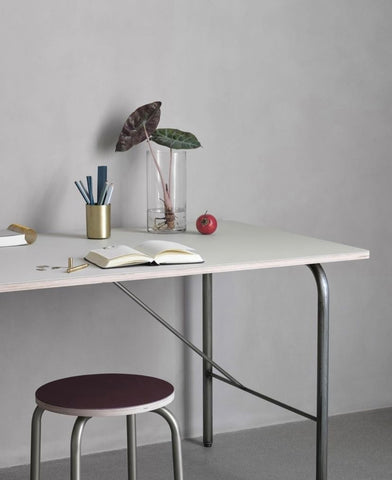
We can adapt the spaces to our needs, whether we work from home or from an office.
Mandatory premise: To organize your workspace you need a WORKSPACE. It may seem obvious for those who go to the office every morning and it is not always the case for those who work from home.
If you work in a shared office it is important that your very personal space is respected and you can organize it according to your needs.
If you work from home, however, the first important thing to do is to find a space and give yourself time. Like in the office: coffee breaks but also intense work sessions without being distracted by the thousand temptations that you can have in your own home.
If possible, choose a space with good natural light, the benefits on reducing stress are proven (among other things, it also helps you sleep better at night).
A piece of advice: when you work in spaces that are not very quiet, it can be useful to plan your work to-dos based on the flow of confusion or to plan to carry out the activities that require more concentration in those moments of the day when you know that the office or your home is more calm.
The first thing to do is clear the space of everything that isn't work.
This brings us to our first tip for organizing your desk: tidiness.
Order reduces distractions, helps keep the mind fresh and reduces the time we would otherwise waste looking for something that isn't in its place. Order is in fact a very personal concept but it always requires that there is a place for everything.
So first of all clean up , the famous decluttering that we talk about so much. Keep only what you really need on your desk within easy reach. Remove everything that is not needed for your work.
You can organize all your documents and loose notes in folders or boxes (maybe they are also nice to look at, remember: creating an environment that you love and are happy to be in is the first step to working well).
The second tip , once you have defined your essentials, is to arrange them on the desk with a logic .
Keep a pen holder handy with the writing tools you use most, a notepad to jot down to-dos , to mark something you shouldn't forget, to scribble during a boring phone call!
Always keep your diary open in front of you (this is why we like flat lay bindings) and perhaps keep all the small accessories that are always very useful (such as paper clips, eraser, sharpener, post it and everything you know that will come in handy during your working day) in suitable containers .

Have you ever heard of the target technique for organizing your desk?
Sit at your desk and draw a circle to divide it into three concentric areas (like a target)
1. In the first area (the most important) there is you, possibly a comfortable chair, your PC and the things you need to work on at that moment.
2. In the second area , the most functional objects for your work: diary or planner, telephone, pencils and pens, notebook or notepad.
3. In the third area , the most "furthest" from you (but which you reach by stretching out your arm), there are all the things you use to tidy up and archive (the famous storage units), the accessories you use less, your lamp and maybe even a purely decorative object such as a plant or a beautiful print.
This brings us to the third tip: personalize .
Adapt your workspace as much as possible to your personal style, make it truly yours, because working in a context in which you can recognize yourself and that you like is always a great help to productivity, as well as an infinite source of inspiration.