

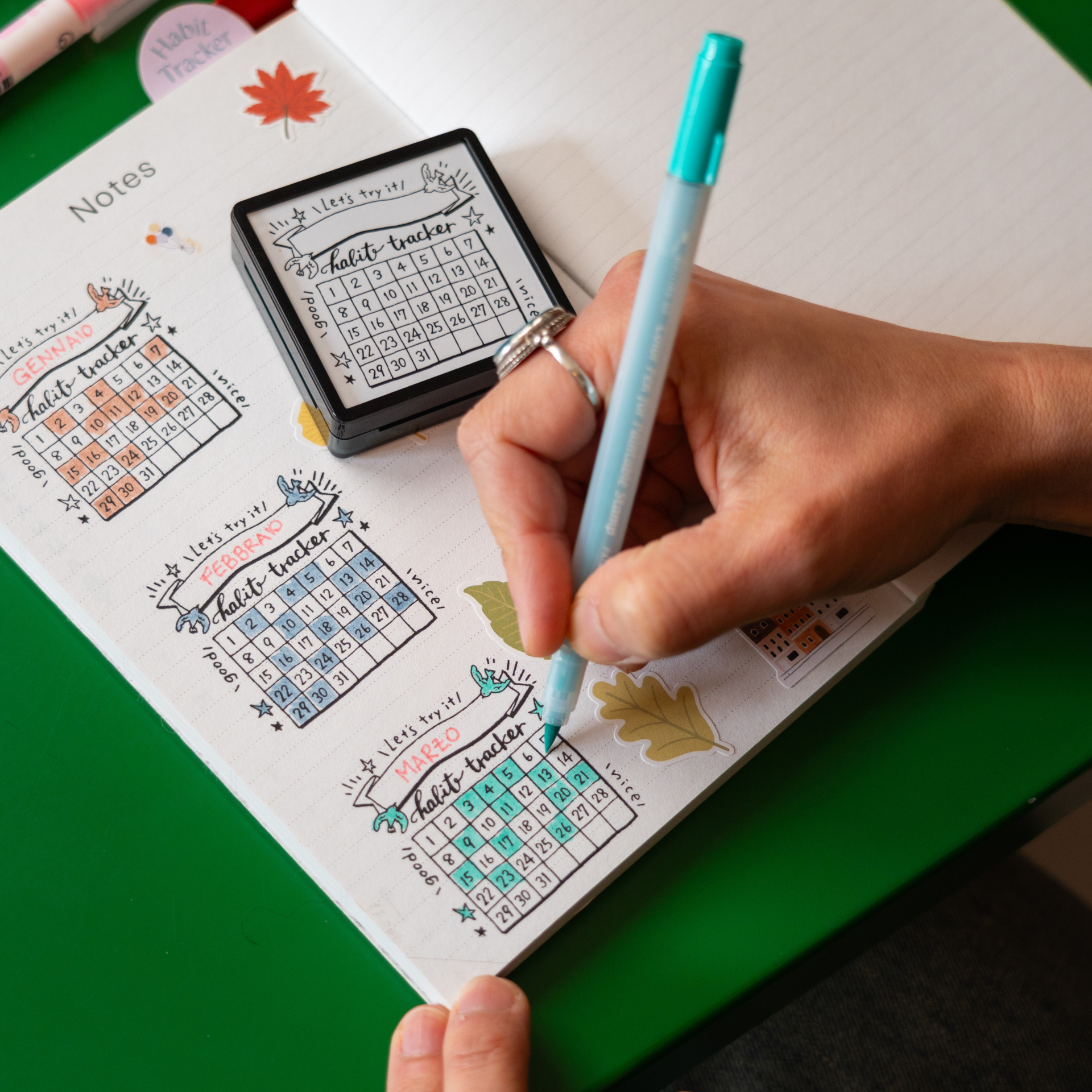
There are times of the year (January, September... but even just any Monday morning) when we feel the need to tidy up . Not just our desk, but our habits.
Sleep more. Drink more water. Read every night. Exercise. Write.
Small gestures that, if repeated over time, truly change your days.
This is where the habit tracker comes in: a simple, yet powerful, tool for turning intentions into concrete actions .
What is a habit tracker (and why does it work)
A habit tracker is a space—in your planner, bullet journal, or on a dedicated sheet of paper—where you keep track of a habit you want to cultivate.
Every day you respect it, you mark an X, a dot, a color.
And day after day, that visual sequence becomes motivation.
A dot, an X, a highlighted line: these are micro-actions.
But over time they become consistent .
It works because:
- makes what you are doing visible
- It helps you not to forget
- It gives you a little daily satisfaction
- shows you progress (even when it feels like you're not making any)
- transform a big goal into a small daily gesture
- And above all: it forces you to be honest with yourself. Without judgment, but with awareness.
Where to start: choose a few (but right) habits
The most common mistake? Wanting to track everything.
My advice is to start with 2 or 3 habits at most , which are really important to you right now.
For example:
- Drink 2L of water
- 20 minute read
- 10 minutes of journaling
- Stretching before bed
- No phone after 10pm
Better a few and sustainable ones than many and frustrating ones.
How to Create a Habit Tracker (3 Easy Ways):
1. In the bullet journal
You can create a monthly grid: the days of the month are vertical, the habits are horizontal
Fill in the box every day. You can use different colors for each habit, or keep it minimal in black and white.
It's perfect if you love customizing and building your pages from scratch.
2. In the weekly planner
If you already use a daily or weekly planner, you can add a small side column with habits, 3 micro boxes under each day, a recurring symbol (✔︎, ●, ✦)
This method is ideal if you want to integrate habits into your daily routine, without creating extra pages.
3. On a dedicated sheet of paper (to be kept in sight)
An A4 or A5 sheet of paper, perhaps hanging on the wall or kept on a clipboard on your desk.
Perfect for “family” or shared habits:
- tidy up the desk
- 30 minutes without screens
- evening reading
When it's right under your eyes, it's harder to forget.
Generally, nothing complicated is needed. All you need is paper, a pen, and a little intention.
You can create your habit tracker in any grid or dotted notebook, or integrate a section into the planner you're already using.
- Enter the month. At the top of the page, indicate the month you are tracking.
- Mark the days. Create a grid with the numbers of the month. You can also write the day of the week above each number: this will help if some habits are tied to specific days (e.g., going to the gym only on Mondays and Thursdays).
-
Set 1–3 goals for the month. Only the ones that really matter now.
Example: sleeping better, or getting back to reading regularly, or losing weight.
The habits you build must support these goals. - Choose the habits you want to track. So, to sleep better, a habit you want to track might be no phone use after 9 p.m. Or, you might track every evening you spend at least 20 minutes reading a good book. Or, to improve your fitness, you might track every day you eat healthily or exercise (or both).
-
Start scoring
Every day you complete a habit, mark it. You can use a fine pen for a minimal grid, a subtle highlighter to create a visual cue, different colors for each habit, stickers, etc.
It doesn't have to be beautiful, although we know that when we like something, we want to do it more. The important thing is that it's clear.
You start with fewer habits than you think; the most common mistake is wanting to change everything at once.
The truth? Consistency comes from simplicity .
If you track fewer habits:
- it's easier to be consistent
- it's easier not to give up
- build momentum (and momentum is everything)
- Better to have three habits maintained than ten abandoned after a week
During the month, come back to your habit tracker page every day and let it become a little ritual .
At the end of the month, stop and observe:
- What was easy?
- What was forced?
- Where have you seen progress?
- What surprised you?
These answers are worth as much as the boxes you tick.
To keep a habit tracker, all you need is a ruler to create the grid and a pen.
If you want to add a pop of color, matching one for each habit you want to track, then the polka dot markers are ideal, available from both Papier Tigre and Midori .
Fineliners are also perfect for coloring boxes.
You can use a stencil to create the grid
Or a stamp.
You can use this very simple bookmark .
These stickers or this washi tape .
If you're interested in this topic, you'll find a very interesting chapter on habit trackers in the bullet journal video course here.
There will be days filled with signs. And empty days.
Both are part of the journey.
A habit tracker works when it is rooted in kindness toward you, not rigidity.
Start small. Map out what really matters and let your days grow, one mark at a time.